
Middle tiers often drive most profit.
The middle tier often becomes the point where value, usage, and willingness to pay finally align.
2 min read
Middle tiers often drive most profit.
Most pricing conversations focus on the extremes.
Entry tiers drive acquisition.
Enterprise tiers drive revenue headlines.
But in many growth-stage companies, the middle tier carries the system.
The middle tier often becomes the point where value, usage, and willingness to pay finally align.
📊 This is where customers expand.
📈 This is where upgrades feel earned.
📉 This is where margin stabilizes.
When the middle tier is designed well, it becomes the center of gravity for the pricing system.
🚩 When it’s designed poorly, the system behaves differently.
You’ll see:
• Most customers stuck in the entry tier
• Heavy discounting to move customers upward
• Enterprise deals that require customization
• Usage growth that doesn’t convert into revenue growth
Nothing is technically wrong.
But the behavioral ladder is broken.
The middle tier ends up either:
• Too weak — buyers stay in entry forever
• Too close to enterprise — buyers hesitate to upgrade
• Too feature-heavy — buyers can’t see why they should move up
When that happens, profit leaks.
To diagnose it, start with behavior, not price.
1️⃣ Step 1: Look at where customers actually land. Pull your distribution.
Example:
📊 If 70–80% of customers cluster in entry, your middle tier isn’t compelling.
📊 If most customers sit in the middle but expansion stalls, the next step isn’t clear.
You’re looking for a signal:
Does usage growth translate into tier movement?
If not, your progression logic is weak.
2️⃣ Step 2: Anchor the middle tier to a real operational improvement. Define what actually gets better when your product works.
Examples:
• Hours of downtime decrease
• Active users increase
• Transactions processed increase
Now design the middle tier to unlock meaningful scale of that improvement.
Example:
Entry tier supports early adoption.
Middle tier supports operational scale.
Enterprise tier supports organizational complexity.
The middle tier should feel like the moment the product becomes essential.
3️⃣ Step 3: Make the upgrade path visible before price.
In demos and proposals:
📈 Show how usage grows.
📈 Show when thresholds are crossed.
📈 Show how the middle tier unlocks scale.
Then introduce cost.
If buyers understand the progression, upgrades feel natural.
If they only see features, they compare instead of expand.
The middle tier isn’t just another option.
It’s the bridge between adoption and expansion.
If you want to pressure-test whether your tiers support that behavior:
🧩 The Profit & Growth Scorecard surfaces where tier design, value metrics, and ICP alignment are breaking momentum.
📊 The Pricing Calculator lets you model how tier thresholds translate into revenue, margin, and payback before changing anything live.
Both are in the featured section of my profile.
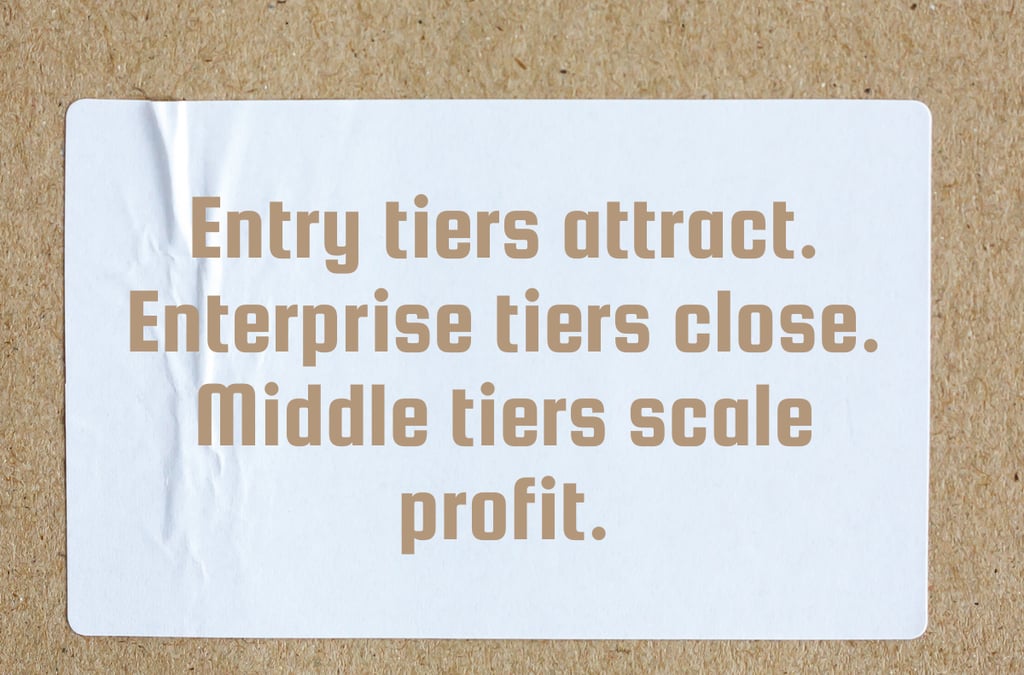
Entry tiers attract.
Enterprise tiers close.
Middle tiers scale profit.
Pivotvia
Reset Stalled Growth. Rebuild Momentum.
Home · Services · About · Get Started
Former Amazon and BlackBerry operator
Fractional CRO and growth advisor